
CPO Certified Pool Operator and Owner of Paradise Pool Service LLC
Published
·
Updated:
·
CPO Certified Pool Operator and Owner of Paradise Pool Service LLC
Published
·
Updated:
·
Chlorine is the most important chemical in your pool.
It’s what keeps the water clean, safe, and free of bacteria and algae. So when your pool starts turning cloudy or green, most homeowners assume they just need to add more chlorine.
But here’s the problem.
You can have chlorine in your pool and still have dirty water.
In reality, chlorine only works when the rest of your water chemistry is in the right condition. If something is off, it becomes weak, ineffective, or gets used up too quickly.
Let’s break down why chlorine stops sanitizing properly and what actually fixes it.
Chlorine’s job is simple:
Kill bacteria and contaminants
Prevent algae growth
Keep water clear and safe
When everything is balanced, chlorine does this efficiently.
When it’s not, problems start showing up fast.
The biggest issue is pH.
If your pH is too high:
Chlorine loses strength
Sanitizing slows down
Algae becomes harder to kill
Even if your chlorine levels look correct on a test, it may not actually be working the way it should.
This is one of the most overlooked problems in pool care.
Stabilizer helps protect chlorine from sunlight.
But too much of it creates a problem.
When stabilizer levels get too high:
Chlorine becomes less active
It takes more chlorine to get the same result
Algae and bacteria survive longer
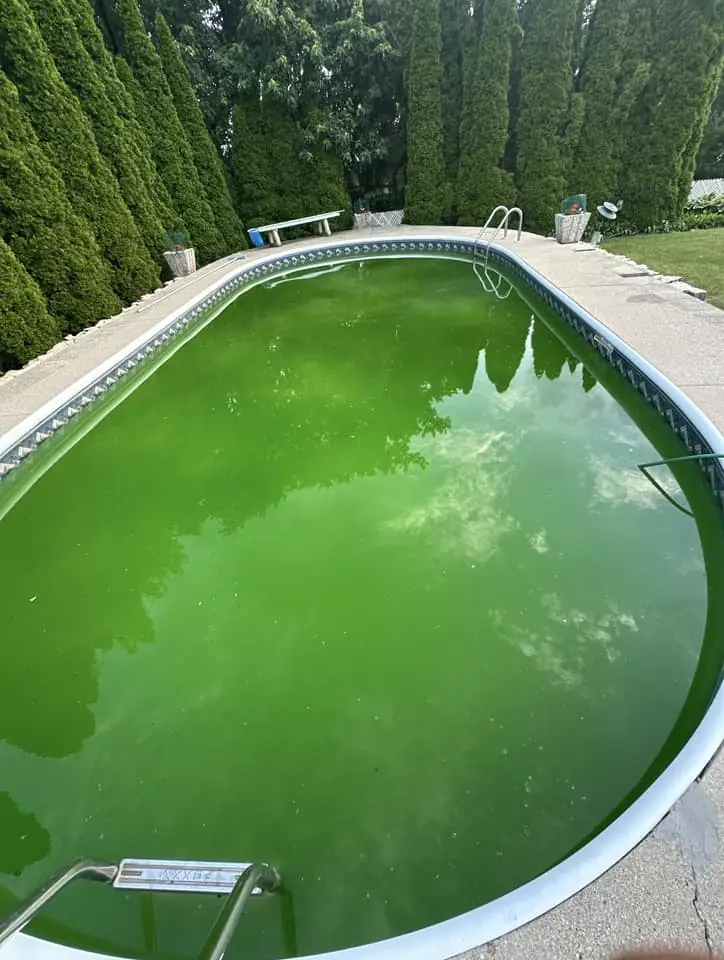
This is often why pools stay green even when chlorine is present.
Chlorine doesn’t just sanitize water. It also reacts with anything in the pool.
That includes:
Leaves and debris
Dirt and dust
Sunscreen and body oils
Early-stage algae
If there’s a lot of contamination, chlorine gets used up quickly and never fully sanitizes the water.
This is why dirty pools struggle to stay clear.
Chlorine needs to move through the entire pool to work.
If circulation is poor, you get:
Dead zones with little to no sanitizer
Algae growth in corners and steps
Uneven chemical distribution
Even if your water tests fine in one area, other parts of the pool may not be protected.
Shocking is meant to boost chlorine levels and reset the water.
But if the underlying issues aren’t fixed, shock won’t solve the problem.
Common reasons shock fails:
pH is out of range
Stabilizer levels are too high
Filter is dirty
Circulation is weak
This leads to a cycle where homeowners keep shocking the pool without real results.
You don’t need a test kit to notice something is off.
Common signs include:
Cloudy or dull water
Green tint or algae growth
Strong chlorine smell
Burning eyes or skin irritation
Needing to add chlorine frequently
These are all signs that chlorine is present but not effective.
Fixing chlorine issues isn’t about adding more. It’s about restoring balance.
A proper approach includes:
Testing full water chemistry
Adjusting pH first
Checking stabilizer levels
Removing debris and cleaning the pool
Ensuring proper filtration and circulation
Once these are corrected, chlorine becomes effective again.
Some pools develop deeper chemical issues.
This is usually the case when:
Water stays cloudy after treatment
Algae keeps coming back
Chemical levels fluctuate constantly
The pool never fully clears
At that point, the issue usually requires a more controlled and precise treatment process.
The key is consistency.
To keep your pool properly sanitized:
Maintain balanced pH levels
Monitor stabilizer levels
Clean debris regularly
Run your filtration system daily
Stay on a weekly maintenance schedule
This keeps chlorine working the way it’s supposed to.
If your pool isn’t responding to chlorine, don’t keep guessing.
A simple plan:
Test your water completely
Adjust pH before anything else
Check for buildup or contamination
Clean and circulate the water
Get professional help if needed
Fix the conditions, and the chlorine will start working again.
Chlorine is only as effective as the environment it’s in.
If your pool isn’t staying clean, the issue usually isn’t the chlorine itself. It’s the water balance, circulation, or buildup around it.
Once those are corrected, everything becomes easier to manage.
Ed Garcia is the owner of Paradise Pool Service LLC, a family-owned pool service company based in Fairfax, VA. With over 20 years of hands-on experience servicing residential and commercial pools across Washington DC and Northern Virginia, Ed leads a team trusted by 150+ pool owners across the DMV area.