
CPO Certified Pool Operator and Owner of Paradise Pool Service LLC
Published
·
Updated:
·
5 min read
CPO Certified Pool Operator and Owner of Paradise Pool Service LLC
Published
·
Updated:
·
5 min read
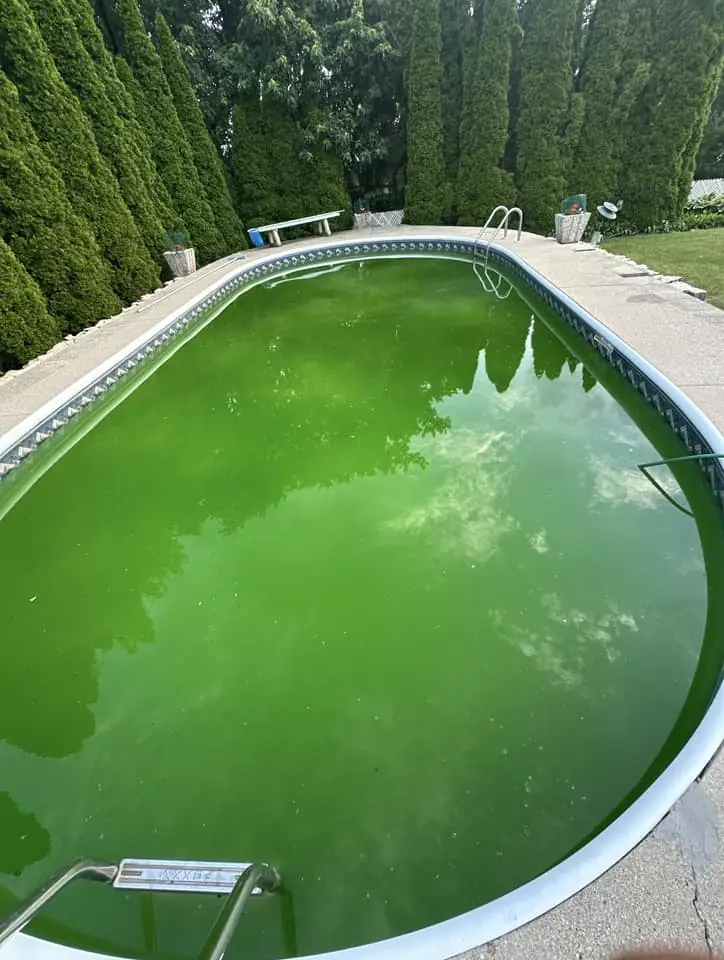
Algae can turn a clear pool green in a day or two, and once it takes hold it will not clear up on its own. Getting rid of it comes down to four steps done in the right order: test your water, shock it, brush every surface, and let the filter run.
This guide walks you through those four steps in plain terms, shows you the CDC chlorine levels that actually kill a bloom, and explains why algae keeps coming back so you can stop it happening again.
If you have algae, your chlorine has almost certainly run out
Shock is what kills the algae, but the filter is what removes it
Algae you do not brush will survive no matter how much chlorine you add
If your stabilizer is too high, your chlorine stops working properly
Your pump needs to run around the clock until the water is clear again
Type | Looks Like | Time to Clear |
|---|---|---|
Green | Cloudy green water, slippery walls | 2 to 5 days |
Yellow / Mustard | Dusty yellow patches in shady spots | 4 to 7 days |
Black | Dark raised spots that feel rough | 1 to 2 weeks |
Green algae floats freely in the water, so it clears fastest. Yellow and black algae root into the pool surface, which is why they take longer and come back if you rush the job.
These four steps each do a different job, and skipping any one of them is the reason most treatments fail.
First, test your water and bring the pH down to 7.2 to 7.4
Then shock the pool hard after sunset to kill the algae
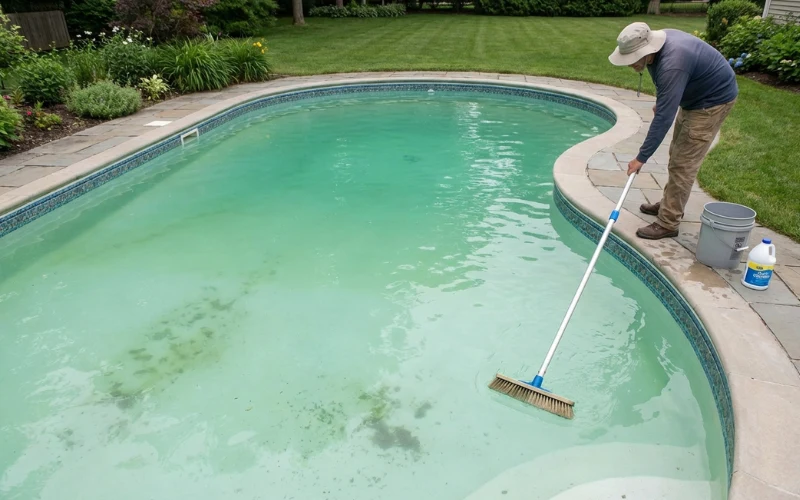
Next, brush every surface so the chlorine can actually reach it
Finally, run the filter around the clock to clear out the dead algae
Do them in that order, because the order is what makes the whole thing work.
The CDC says a safe pool should hold free chlorine of at least 1 ppm with a pH between 7.2 and 7.8. That is enough to keep an already clear pool clear, but it is nowhere near enough to kill an active bloom.
To clear green algae, you need to push free chlorine up to around 10 to 12 ppm
Yellow algae is tougher and needs roughly 15 to 20 ppm
Black algae is the hardest and needs 20 ppm or more, held for several days
Do not let anyone swim until the chlorine drops back under 4 ppm
You also have to keep topping the chlorine back up as it falls, because the algae eats through it within hours.
Because direct sunlight burns through chlorine within hours, so if you shock during the day, half your dose is gone before it has a chance to work.
Add your shock after sunset, with the pump running
If you are using granular shock, dissolve it in a bucket of water first
Never mix two different shock products together, as some react dangerously
Leave the pump running all night so the chlorine circulates fully
If your water goes cloudy grey after shocking, that is actually dead algae, and it means the treatment is working.
Grey or milky water is a good sign, not a setback
The job now is for your filter to pull all that dead algae out
Keep the pump running 24 hours a day
Clean or backwash the filter every day until it clears
If it is still grey after three days, the problem is usually your filter, not your chemistry.
If algae returns within a couple of weeks, it means the underlying cause was never actually fixed.
Your chlorine dropped below 1 ppm at some point and let it back in
Your pump is not running long enough to turn the water over each day
Your stabilizer has crept too high and quietly stopped your chlorine working
Storms and pollen strip chlorine fast, which hits Northern Virginia pools hard
Some blooms end up costing more in wasted chemicals than a service visit would have.
You are dealing with black algae, which grows back from a single root
Your pool is still green after three full days of correct treatment
Your stabilizer is over 100 ppm and needs a partial drain done safely
The same bloom comes back every single season no matter what you do
Clearing algae really comes down to getting the order right: fix your pH, shock hard after dark, brush every surface, and keep the filter running until your chlorine stops dropping overnight. Do that and even a badly neglected green pool will clear within a week.
If you would rather hand it off, Paradise Pool Service clears green pools across Fairfax, McLean, Arlington, Alexandria and Washington DC, with same day response for urgent situations and a free on site quote. You can check coverage on the service area page.
How long does it take to clear a green pool?
Will shock alone clear my pool?
Why is my pool cloudy after shocking?
Can I swim in a pool with algae?
Do algaecides actually work?
Ed Garcia is the owner of Paradise Pool Service LLC, a family-owned pool service company based in Fairfax, VA. With over 20 years of hands-on experience servicing residential and commercial pools across Washington DC and Northern Virginia, Ed leads a team trusted by 150+ pool owners across the DMV area.