

CPO Certified Pool Operator and Owner of Paradise Pool Service LLC
Published
·
Updated:
·
6 min. read
CPO Certified Pool Operator and Owner of Paradise Pool Service LLC
Published
·
Updated:
·
6 min. read
Keeping a pool clear isn't hard, but it is relentless, and that's what trips people up. The same short list of jobs needs doing every week, and skipping it for a fortnight is usually how a clear pool turns green.
This checklist walks through everything a pool needs weekly, in the order that makes it quickest, plus the target numbers to aim for and a few habits that make the whole thing easier.
The full routine takes about 60 minutes weekly
Always clean your pool before you test the water
Balanced water is what keeps the pool clear
Empty your pool baskets so the pump isn't straining
What to Test | Target Range |
|---|---|
pH | 7.2 to 7.6 |
Free chlorine | 1 to 3 ppm |
Total alkalinity | 80 to 120 ppm |
Calcium hardness | 200 to 400 ppm |
Water level | Middle of the skimmer opening |
Pull your water sample about 18 inches down and away from the return jets, so you're testing the real pool, not fresh return water.
Start here, because clogged baskets choke your circulation and make everything else less effective. A skimmer packed with leaves means the pump is straining all week.
Empty the skimmer basket
Empty the pump strainer basket
Rinse out any built-up debris
Check for cracks while they're out
A pump fighting against full baskets works harder, costs more to run, and wears out sooner. So this 60-second job protects your most expensive equipment.
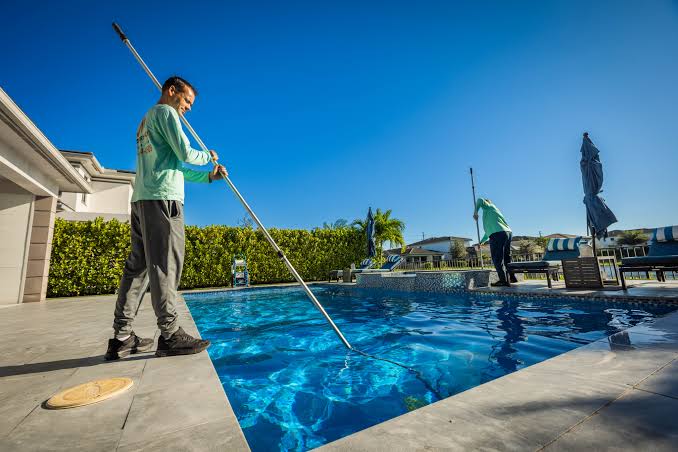
Next, skim the surface and brush the walls, before anything settles or takes hold. Leaves left floating sink and stain, and algae starts as an invisible film long before you can see green.
Skim the surface with a leaf net
Brush walls, steps and the waterline
Focus on corners and behind ladders
Brush toward the main drain
Those low-circulation spots behind steps and ladders are where algae always starts, because the sanitizer barely reaches them. So that's exactly where the brush matters most.
Brushing loosens debris, but vacuuming is what actually removes it. Skip this and fine dirt just resettles into a gritty layer on the floor.
Vacuum in slow, overlapping passes
Go slow to avoid clouding the water
Cover the whole floor, not just the middle
A robotic cleaner can do this for you
Rushing the vacuum stirs everything back up, which undoes the work. Slow passes are the difference between clear water and a cloudy afternoon.
Now test the water, and do it before dosing anything, because adding chemicals blind is how pools swing from one problem to another. Testing first tells you what the water actually needs.
Test pH, chlorine and alkalinity weekly
Sample 18 inches down, away from jets
Use fresh strips or a drop kit
Test twice a week in peak summer heat
As Certified Pool Operators, this is the step we'd never skip, because every other decision depends on it. A clear-looking pool can still be badly out of balance underneath.
Once you know your numbers, adjust them carefully. The mistake is dumping in a big correction, overshooting, and chasing the balance back the other way all week.
Add small amounts, then let it circulate
Retest before adding any more
Never mix chemicals together directly
Add one chemical at a time
Balanced water isn't just about clarity. It's what stops the water quietly corroding your surfaces and equipment from the inside out.
With the water balanced, make sure your sanitizer will hold all week. Chlorine gets consumed constantly by sun, swimmers and debris, so the level needs topping back up.
Check free chlorine is 1 to 3 ppm
Refill tablets in your feeder or chlorinator
Never put tablets in the skimmer basket
Buy fresh chlorine, it weakens in storage
Tablets in the skimmer send acidic water straight through your pump and heater when the system's off. It's one of the most common causes of premature equipment damage we see across our 150+ pools.
Your filter is the engine behind clear water, and the pressure gauge tells you when it needs attention. A clogged filter slows circulation and clouds the whole pool.
Note the pressure on the gauge
Backwash or rinse at 8 to 10 psi above clean
Rinse cartridge filters with a hose
Run the pump 8 to 12 hours daily
That 8 to 10 psi rise above the clean baseline is your trigger to clean it. Cleaning too often actually reduces filtration, so wait for the number rather than doing it on a fixed day.
Finally, check the water level, since it affects both skimming and your pump. The sweet spot is the middle of the skimmer opening.
Keep water at the skimmer's midpoint
Top up if it drops below halfway
Too low can burn out the pump
Too high and the skimmer stops working
If you're topping up far more than a hot week would explain, that's worth investigating. Persistent water loss often points to a leak rather than evaporation.
Shocking isn't a weekly job, but it belongs on the checklist for when the water needs a reset. Do it after anything that overwhelms your normal chlorine.
After heavy rain or a storm
After a party or heavy swimmer load
When the water looks dull or cloudy
Always at night, so sun doesn't burn it off
A good weekly routine is about an hour: empty the baskets, skim and brush, vacuum, then test and balance the water. Stay on top of that and the big problems mostly never show up.
If you'd rather hand it off, Paradise Pool Service handles weekly and bi-weekly upkeep for 150+ pool owners across Fairfax, McLean, Arlington, Alexandria and Washington DC, with a free on site quote before anything starts. You can check coverage on the service area page.
How long should weekly pool maintenance take?
What order should I do the pool maintenance in?
How often should I test my pool water?
How long should I run my pool pump each day?
When do I need to shock the pool?
Ed Garcia is the owner of Paradise Pool Service LLC, a family-owned pool service company based in Fairfax, VA. With over 20 years of hands-on experience servicing residential and commercial pools across Washington DC and Northern Virginia, Ed leads a team trusted by 150+ pool owners across the DMV area.