
CPO Certified Pool Operator and Owner of Paradise Pool Service LLC
Published
·
Updated:
·
CPO Certified Pool Operator and Owner of Paradise Pool Service LLC
Published
·
Updated:
·
Most pool owners never think about phosphates until they receive a water test showing their levels are high.
That often leads to more questions than answers.
What are phosphates? Are they dangerous? Do they actually affect the pool?
While phosphates do not directly turn pool water green or cloudy, they can create conditions that make pool maintenance much more difficult.
Understanding how phosphates affect your pool can help you prevent algae growth, reduce chemical demand, and keep your water cleaner over time.
Phosphates are naturally occurring compounds that enter pool water from a variety of sources.
Common sources include:
Leaves and organic debris
Grass clippings
Pollen
Fertilizers
Rainwater runoff
Swimmer contamination
Over time, phosphates accumulate in the water unless they are removed through treatment or water replacement.
Phosphates are not harmful to swimmers.
The problem is that phosphates act as a food source for algae.
The more phosphates available, the easier it becomes for algae to grow when sanitizer levels drop or water balance becomes unstable.
Think of phosphates as fertilizer for algae.
They do not create algae on their own, but they make it easier for algae to spread when other conditions allow it.
One of the biggest concerns with high phosphate levels is their relationship with algae.
When phosphates are elevated:
Algae can grow more aggressively
Algae outbreaks become harder to control
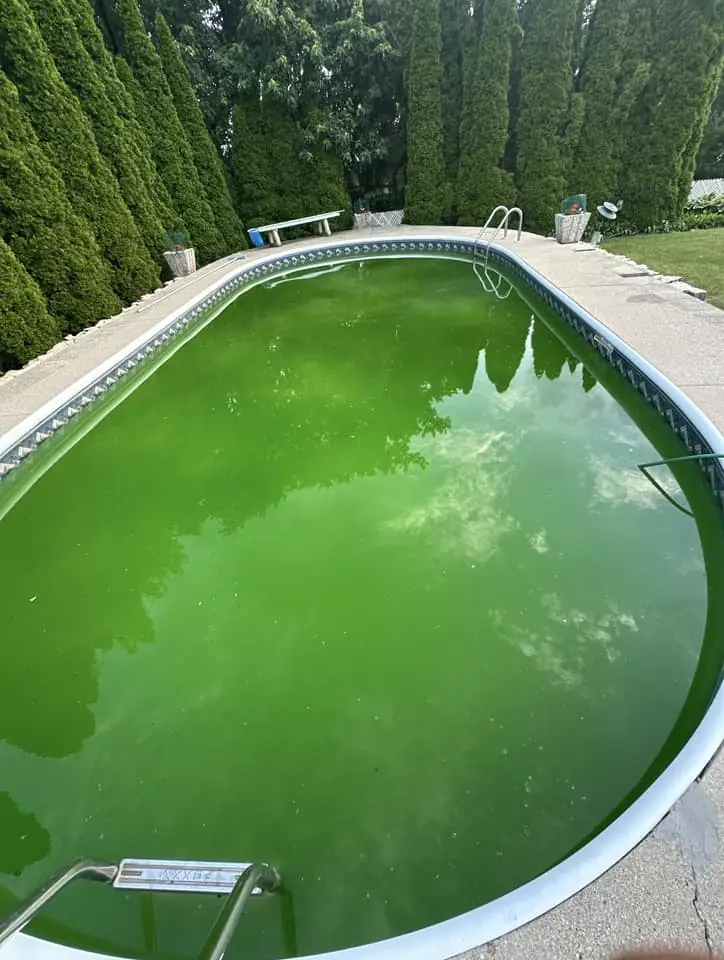
Green pool problems become more common
Algae may return more quickly after treatment
Pools with recurring algae issues often have elevated phosphate levels contributing to the problem.
High phosphate levels often increase the overall maintenance burden on a pool.
As algae and contaminants become easier to support, chlorine is forced to work harder to maintain sanitation.
This can lead to:
Increased chlorine usage
More frequent shocking
Faster chlorine depletion
Greater maintenance costs
Many pool owners notice they are adding more chlorine than usual without understanding why.
Phosphates themselves do not make pool water cloudy.
However, the algae growth they support often does.
This can result in:
Dull water appearance
Reduced clarity
Recurring cloudiness
Increased filtration demand
If water clarity problems keep returning despite regular maintenance, phosphates may be contributing to the issue.
High phosphate levels are not always obvious.
Some pools show no visible symptoms at all.
However, common warning signs include:
Recurring algae problems
Chlorine disappearing quickly
Frequent shocking requirements
Cloudy water that returns repeatedly
Water tests showing elevated phosphate readings
Many homeowners only discover the issue after a professional water test.
Phosphates enter the pool constantly throughout the season.
Common causes include:
Nearby landscaping
Fertilizer runoff
Decaying leaves
Heavy rain
Organic debris
Swimmer waste and lotions
Pools located near trees or heavily landscaped areas often accumulate phosphates more quickly.
This is one of the most common misconceptions.
Standard pool filters are designed to remove physical debris from the water.
They are not designed to remove dissolved phosphates directly.
This includes:
Cartridge filters
Sand filters
DE filters
Because phosphates are dissolved in the water, specialized phosphate-removal products are often needed to lower levels effectively.
Not always.
In many cases, high phosphate levels can be managed without draining the pool.
Possible solutions include:
Phosphate remover treatments
Improved debris control
Better water chemistry management
Consistent filtration and cleaning
Partial water replacement may sometimes be recommended when phosphate levels become extremely high, but draining is not automatically required in every situation.
The best approach is reducing both phosphate levels and the sources introducing them.
Helpful steps include:
Remove leaves quickly
Skim debris regularly
Clean filters consistently
Avoid fertilizer contamination
Maintain proper chlorine levels
Use phosphate removers when necessary
Preventing phosphate buildup is often easier than correcting severe levels later.
Not necessarily.
Some pools operate with elevated phosphate levels and experience very few issues.
The difference usually comes down to overall maintenance.
If the pool maintains:
Proper chlorine levels
Good circulation
Effective filtration
Balanced water chemistry
high phosphates may not immediately cause noticeable problems.
However, elevated levels leave less room for error when maintenance slips.
If algae keeps returning despite proper maintenance, it may be worth having phosphate levels tested.
A pool professional can help if:
Algae returns repeatedly
Chlorine demand remains unusually high
Water clarity problems continue
Phosphate readings remain elevated after treatment
Testing helps determine whether phosphates are contributing to the larger issue.
High phosphates do not directly turn your pool green or cloudy, but they can create conditions that make maintenance much more difficult.
Because phosphates act as a food source for algae, elevated levels often lead to increased chlorine demand, recurring algae problems, and ongoing water quality issues.
Keeping debris out of the pool, maintaining proper water chemistry, and addressing phosphate buildup when necessary can help keep your pool cleaner, clearer, and easier to manage throughout the season.
Ed Garcia is the owner of Paradise Pool Service LLC, a family-owned pool service company based in Fairfax, VA. With over 20 years of hands-on experience servicing residential and commercial pools across Washington DC and Northern Virginia, Ed leads a team trusted by 150+ pool owners across the DMV area.