
CPO Certified Pool Operator and Owner of Paradise Pool Service LLC
Published
·
Updated:
·
4 min. read
CPO Certified Pool Operator and Owner of Paradise Pool Service LLC
Published
·
Updated:
·
4 min. read
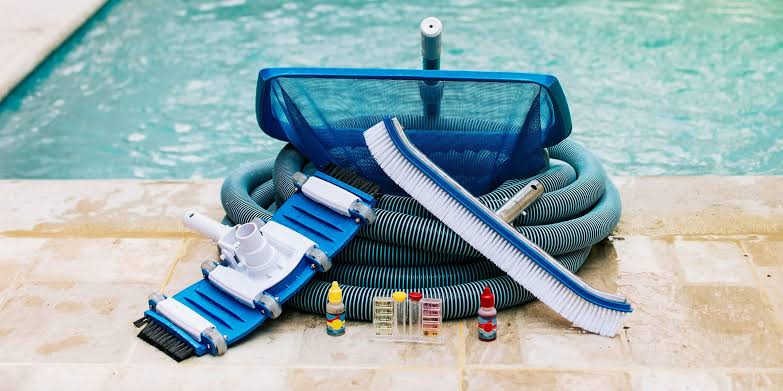
Most new pool owners walk into a pool store and walk out with far more equipment than they will ever use. The reality is that a handful of basic tools handles almost all routine pool care. This guide covers what each tool actually does, which ones you genuinely need, and which ones are a waste of money.
Five tools cover 90% of routine pool care
A telescoping pole connects to nearly everything else
The wrong brush type can permanently damage your pool
Your test kit matters more than any cleaning tool
The telescoping pole is the backbone of your entire setup. Your skimmer net, brush, and manual vacuum all attach to it, which means if the pole is bad, every other tool becomes harder to use.
Buy one good aluminium pole rather than replacing a cheap plastic one every season. Cheap poles bend under pressure, the locking mechanism fails, and you end up fighting the tool instead of cleaning the pool. A quality pole should extend to at least 16 feet so it can reach the deep end floor comfortably.
Extends to reach the pool floor easily
Connects to nets, brushes, and vacuums
Buy one quality pole, not three cheap ones
The skimmer net is the tool you will reach for most often. Its job is to remove leaves, insects, and floating debris before they sink to the bottom and start breaking down.
This matters more than most people realise. Once organic debris sinks and decomposes, it consumes chlorine, feeds algae, and stains your pool surface. Five minutes of skimming daily prevents hours of work later. Flat nets skim the surface only, while deep bag nets can also scoop debris off the floor, which makes them the more versatile choice for most homeowners.
Flat nets skim the surface only
Deep bag nets also reach the floor
Deep bag is more versatile for most pools
Brushing weekly is what keeps algae from establishing itself on your walls and steps. Algae takes hold in the spots water does not circulate well, and no amount of chlorine fully compensates for a pool that never gets brushed.
The critical detail here is bristle type. Nylon bristles are correct for vinyl liner and fiberglass pools. Stainless steel bristles are for concrete, gunite, and plaster surfaces only. Using a steel brush on a vinyl liner will tear it, and that is an expensive mistake that a $20 tool can cause.
Nylon bristles for vinyl and fiberglass
Stainless steel for concrete and plaster
Wrong bristles will damage your pool surface
A manual vacuum attaches to your pole and connects to your skimmer, using your pump's suction to pull debris off the pool floor. It is the most affordable option and works perfectly well.
The tradeoff is effort. Vacuuming a pool manually takes 30 to 45 minutes of actual physical work each time, and it needs doing weekly during peak season. For smaller pools or homeowners who do not mind the work, it is entirely sufficient. For larger pools, it becomes a chore people start skipping, which is when problems begin.
Cheapest option, uses your existing pump
Takes 30 to 45 minutes each time
Best for smaller pools or occasional use
A robotic cleaner is a self-contained unit that runs independently of your pool's pump and filtration system. You drop it in, it scrubs the floor and walls on its own, and you pull it out when finished.
The upfront cost is significant, typically $400 to $1,200 depending on the model. But for larger pools or heavily used ones, it pays for itself in time saved and in the problems it prevents by ensuring the pool actually gets cleaned consistently rather than whenever someone feels like doing it. Most quality units also filter fine debris that your main filter would otherwise have to handle.
Runs independently of your pump
Costs $400 to $1,200 upfront
Worth it for larger or heavily used pools
If you buy only one thing, make it a good test kit. You can skim and vacuum a pool perfectly and still end up with green water if your chemistry is off, because chemistry is what actually keeps a pool safe and clear.
Test strips are quick and convenient but less precise, particularly on chlorine and alkalinity readings. Liquid test kits take a couple of minutes longer but give significantly more accurate results, which matters when you are trying to diagnose a problem rather than just confirm everything is fine. During a Virginia summer you should be testing two to three times per week, and always the same day after heavy rain.
Test strips are fast but less accurate
Liquid kits give far more precise readings
Test 2 to 3 times weekly in summer
Tool | Cost | How Often Used | Essential? |
|---|---|---|---|
Telescoping pole | $20 to $50 | Every use | Yes |
Skimmer net | $10 to $30 | Daily | Yes |
Pool brush | $15 to $40 | Weekly | Yes |
Manual vacuum | $30 to $80 | Weekly | Yes |
Test kit | $15 to $60 | 2 to 3 times weekly | Yes |
Robotic cleaner | $400 to $1,200 | Weekly | Optional |
Leaf rake | $20 to $40 | After storms | Optional |
The most common mistake is buying multiple brushes or vacuums when one correct tool does the job. If you have the right brush for your surface and a working vacuum, adding more equipment does not make your pool cleaner. It just makes your shed fuller.
Specialty cleaners for problems you do not have
Multiple brushes when one correct type works
Gadgets that duplicate tools you already own
Sometimes homeowners buy more equipment because the pool still looks wrong, when the actual issue has nothing to do with cleaning at all.
Cloudy water is almost always a filtration problem, meaning a dirty filter or a pump not running long enough. Recurring algae is a chemistry problem, meaning chlorine or pH drifting out of range. Neither of those gets fixed by buying a better vacuum. If you are cleaning consistently and the water still is not right, the problem is upstream in your equipment pad, not in your hands.
Cloudy water usually means filtration issues
Recurring algae points to chemistry problems
Neither is solved by buying more equipment
Five tools cover almost everything: a pole, a net, a brush, a vacuum, and a test kit. Everything beyond that is optional and situational.
If you would rather not manage any of it, get a free quote from Paradise Pool Service and we will handle the equipment, the chemistry, and the schedule for you.
What pool cleaning equipment do I actually need?
Is a robotic pool cleaner worth it?
What kind of pool brush should I use?
How often should I test my pool water?
Why is my pool still dirty even with the right equipment?
Ed Garcia is the owner of Paradise Pool Service LLC, a family-owned pool service company based in Fairfax, VA. With over 20 years of hands-on experience servicing residential and commercial pools across Washington DC and Northern Virginia, Ed leads a team trusted by 150+ pool owners across the DMV area.